Words may look similar at first glance, but their meanings are not the same. This is exactly the case with these two words, “annunciate” vs “enunciate.”
Both of these words come from the Latin language, and both words mean to speak or to announce. However, their meanings are different from each other in a very interesting way.
In this guide, we will look at the difference between them and how to use them in real life. We will also look at common mistakes. After reading what I teach you here today, you will be able to distinguish between annunciate and enunciate and will never be deceived by them again.
Why do people get confused between annunciate vs enunciate?
You must have heard someone say at some point, “It would be a favor if you could annunciate your words?” To the ears, this sounds perfectly correct, but it is not correct at all. The right word here is “enunciate.”
The reasons for this confusion:
The sounds of both words are almost identical to each other.
Both are related to conversation.
Their roots are actually different, which is why they hold different meanings. Let’s understand this confusion in detail today and end it for you.
The Basic Difference
The easiest way to remember these words is this:
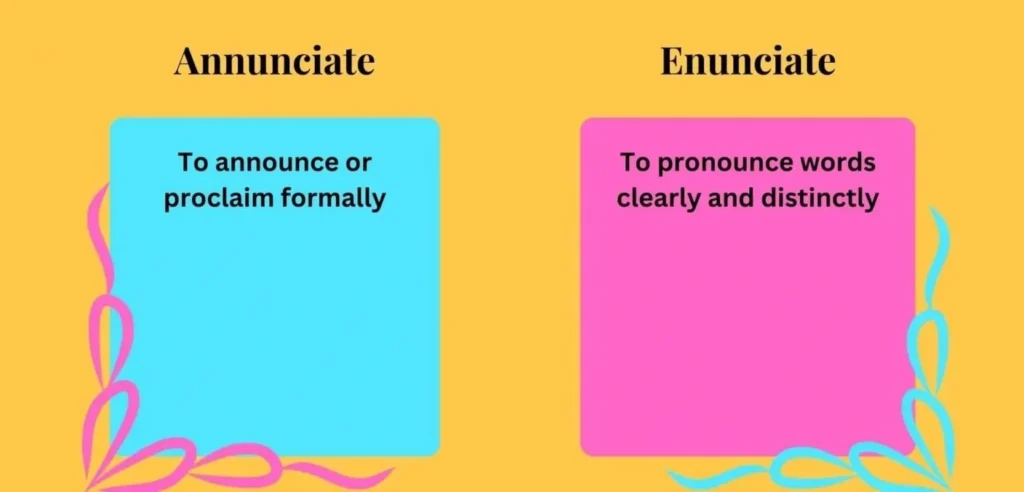
We annunciate a message, whereas we enunciate our words.
Annunciate: When a piece of news is announced publicly.
Enunciate: When words are spoken so clearly that the person in front can understand them easily.
word |
meaning |
|
Annunciate |
Annunciate means to announce, which is done religiously or formally. |
|
Enunciate |
Enunciate means how clearly you speak a word so that the person in front can understand it easily. |
Searching for Origins
Although both words are Latin words. But then with the passage of time, their paths diverged.
The word annunciate is derived from annuntiare, which literally means to announce.
Prefix ad – (towards someone) “nuntiare“ (means to declare) annuntiare
So many centuries passed and in the meantime its meaning changed to become annunciate. Which means to announce and it is mostly used in religious matters.
The word enunciate has come from enuntiare. Which means, to speak something out,
prefix “e” (to come out) + “nuntiare” (to speak or to say) – enuntiare
This then changed into the word enunciate which involves speaking a word clearly and making the pronunciation correct.
If seen, nuntiare is present in both words. But the prefixes create a difference between them.
An means pointing towards something like an announcement.
E means the outward expression of something, to speak a word clearly
How meanings changed over time
In the beginning, annunciate was used for every kind of formal announcement. But as time passed, it remained limited to specific religious announcements or the announcement of big ceremonies. Nowadays, we mostly see it in either government announcements or in religious books.
Example
An angel annunciated the birth of the Messiah.
A church annunciated the start of Lent.
And if we look on the other side, enunciate has increased its role in the language of daily life. This tells how we express our words. And how we pronounce them. This word is often used in communication training, broadcasting, and is very famous.
Example
Speakers pronounce words clearly so that everyone can understand.
This change in the word shows how language molds itself with time. Where one word stopped at one place, the other word became famous everywhere.

Understanding “Annunciate”
Annunciate often carries a formal tone. Its most recognized usage is found in the Christian religion. It means annunciate refers to a specific time, such as when the angel delivered the news of the birth of Hazrat Isa (Jesus) to Maryam (Mary).
This sacred connection has given a shape to the usage of this word. Nowadays, apart from religious occasions, it is used very rarely.
Example
The Bishop annunciated the start of a holy month.
The royal decree was annunciated from the royal court during the coronation.
Facts about Annunciate
Part of speech: Verb (fail)
Forms: annunciated, annunciation, annunciating
Context: religious, ceremonial
Important Difference
Don’t say this: Don’t say he annunciated the words clearly.
Say this: That he enunciated the words clearly.
If the matter is about speaking the words out loud, it is called enunciate.
The ability to speak words clearly
I have already told you before that the meaning of enunciate is to speak words with clarity and precision. This is something for which you have to take training from a coach to gain mastery.
When you enunciate any word, you speak every word with such cleanliness that the people in front of you can understand your words very easily.
Examples
When he does poetry, he speaks the words in a very clean and clear way.
For a public speaker, it is important to speak words clearly so that people can easily understand their point.
Practical Importance
Teaching: If you perform enunciation of words, you benefit those people [so] they learn quickly; this is not the original language.
Broadcasting: On radio or TV, this ensures that all your words are heard clearly everywhere.
Leadership: If you speak clearly, it builds your influence (rob).
Tips for better enunciation
|
Reduce speaking speed |
If you speak words too fast, your words come out half-finished. |
|
Open the mouth fully |
If you speak words by opening the mouth fully, the words will come out completely. |
|
Record your voice |
By recording and listening to your voice again, you find out your own mistakes. |
This is the word and this is the thing: enunciation creates a difference between a confident speaker and one who is unable to speak [clearly].
FAQs
Conclusion
Your language reflects the clarity of your thoughts. If you understand the difference between enunciate and annunciate, you can improve both your conversation and your writing.